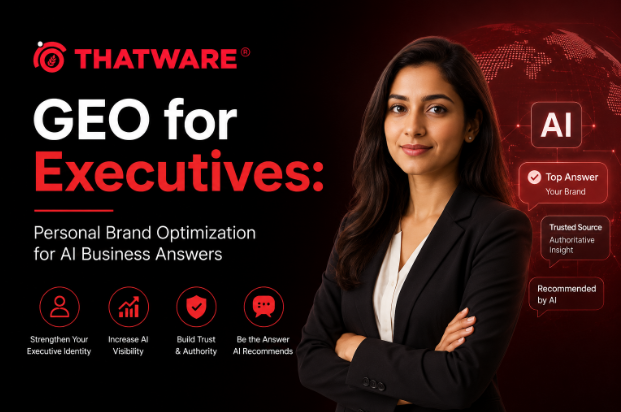
Ask an AI assistant who the leading voices in enterprise software are, or who to follow for insights on supply chain resilience, or which executives are shaping conversations in fintech — and you’ll get names. Specific, confident names. The AI isn’t guessing randomly. It’s drawing on a web of signals: published content, cited interviews, conference appearances, industry recognition, professional association memberships, and countless other data points that collectively establish someone as an authority in a given domain.
If your name doesn’t come up in those answers, it’s not because you lack expertise. It’s likely because the signals that would make your expertise legible to an AI system aren’t there in sufficient depth, or they’re inconsistent, or they’re simply not on the AI’s radar.
That’s what personal brand GEO is about — and for executives who rely on thought leadership to drive business outcomes, it’s becoming increasingly important to get this right.
Why Executive Visibility in AI Has Business Consequences
The connection between executive visibility and business outcomes used to be somewhat indirect — brand awareness, perceived credibility, the occasional referral from someone who read an article. The connection still exists, but the pathway has changed.
Today, when a prospective client is evaluating your firm, there’s a good chance they’re asking an AI assistant somewhere in that process. “Who are the recognized experts in [your domain]?” “Which firms have strong leadership in [your specialty]?” The people and companies that get cited in those answers enter the consideration set before a first conversation ever happens. The ones that don’t may never get the chance to make their case.
For B2B services firms especially — consulting, legal, financial advisory, technology — executive authority is often the differentiator. Two firms can offer similar services; the one whose partners are visibly recognized as experts in AI-generated answers has a head start that’s increasingly hard to overcome.
How AI Systems Evaluate Individual Authority
Unlike corporate entities, where structured data and website architecture play a large role, personal authority in AI systems is built primarily through external signals. What matters:
Published work with verifiable attribution. Articles, papers, reports, and commentary published under your name on authoritative platforms. The more these are cited or referenced by other sources, the stronger the signal.
Speaking and event presence. Conference appearances, keynotes, podcast interviews — these generate transcript content, event listings, and third-party references that contribute to your entity footprint. An executive who speaks regularly at recognized industry events has a meaningfully different AI profile than one who doesn’t.
Media coverage and expert quotes. Being cited in journalism — whether trade press, business media, or niche industry publications — as an expert source is a high-quality external signal. AI systems treat journalist-attributed quotes as strong credibility indicators.
Professional platform completeness. LinkedIn, Wikipedia (where appropriate), Crunchbase, professional association pages — these need to accurately, comprehensively, and consistently represent who you are and what you’re an expert in. Gaps and inconsistencies create ambiguity.
Third-party recognition. Awards, rankings, board memberships, advisory roles — these show up in the text AI systems draw on and contribute to the overall authority picture.
Thought Leadership That AI Can Actually Use
There’s a meaningful difference between thought leadership that humans find compelling and thought leadership that AI systems can effectively reference. The former can live in long-form narrative, nuanced argument, conversational language. The latter needs to be structured, attributable, and verifiable.
The best GEO agency for thought leadership will help you develop content that serves both audiences. Practically, this means:
-
Publishing under your full name consistently, not just initials or pseudonyms
-
Including clear expertise markers in author bios (specific credentials, years of experience, named areas of focus)
-
Making specific, citable claims rather than vague assertions — “based on our analysis of 200 enterprise deployments” gives an AI system something to work with; “in our experience” doesn’t
-
Linking to verifiable supporting evidence where claims are based on research
-
Distributing content to platforms that carry authority in your industry, not just your own blog
None of this requires you to change your voice or compromise the quality of your thinking. It’s mostly about making sure the structure and distribution choices support AI legibility alongside human readability.
The Entity Optimization Layer for Individuals
Just like organizations, individual executives benefit from having a clean, consistent entity presence across the web. This means ensuring that every major platform where you appear describes your expertise accurately and consistently — same name format, same professional focus, aligned biography.
The most common problems: outdated bios that reflect a previous role, inconsistent name formatting across platforms (John vs. Jonathan, surname first vs. last), LinkedIn skills and endorsements that don’t align with your actual focus areas, and a near-total absence from platforms that carry authority in your field.
Enterprise GEO optimization agency work for executives typically involves auditing this landscape, identifying the gaps and inconsistencies, and developing a systematic plan to address them — combined with a content and distribution strategy that builds the external reference footprint over time.
A Realistic View of the Timeline
Building the kind of AI-legible executive authority that shows up consistently in relevant answers takes time. Not years — but months. Typically, six to twelve months of consistent effort produces meaningful visibility in specific query clusters; broader category recognition takes longer and requires more external citation depth.
The temptation is to treat this as a one-time project: write a few articles, clean up the LinkedIn, call it done. That’s not how it works. AI systems are continuously updated, and the brands and individuals that maintain consistent visibility are the ones producing a steady stream of authoritative, externally referenced content.
For executives who don’t have bandwidth to manage this personally (which is most of them), working with a specialized partner makes sense — not to produce generic content under your name, but to build the infrastructure, handle the distribution, and ensure the technical optimization layer is solid while you focus on the actual thinking and expertise that drives the content.
Who This Matters Most For
Honestly, GEO for personal brand optimization matters most to executives in industries where expertise is the product — professional services, advisory, technology leadership, financial services, healthcare. If your clients and prospects make decisions based partly on who they believe is most credible in your space, AI visibility is directly relevant to your business development.
It also matters increasingly for executives navigating competitive talent markets, board candidacy, speaking invitations, and media opportunities. AI-assisted research is becoming the norm in hiring, vetting, and selection processes of all kinds. Who shows up as a recognized expert in those searches matters.
In an AI-mediated world, authority isn’t just felt — it’s structured, verified, and searchable. The executives who understand this early will shape how AI systems define expertise in their fields.